
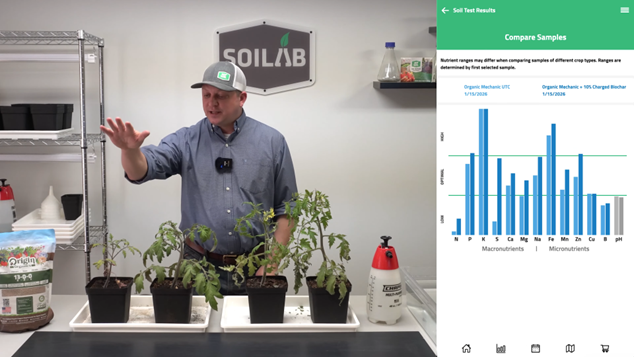
Gardeners hear constant claims about “miracle” soil products, but very few side‑by‑side tests show what actually happens in the root zone. In this trial, four soil treatments—no amendment, charged biochar, Origin fertilizer, and charged biochar + Origin fertilizer—were grown out and then evaluated with a MySoil soil test and a root wash check to see which approach really improved soil and plant performance.
If you’d rather watch this comparison than read about it, you can click the thumbnail below or find the YouTube video here.

We compared four clearly defined approaches so you can see how each one changes soil and root growth over time.
· Untreated soil: No amendments or fertilizer, just the baseline bagged soil as a control.
· Biochar only: Soil amended with 10% charged biochar by volume to test its impact on soil nutrition and both aboveground and belowground plant growth.
· Origin Fertilizer: Soil amended with Origin’s 13-0-0 at the rate recommended based on the MySoil test results.
· Origin fertilizer + Biochar: Soil amended with 10% charged biochar by volume and fertilized with Origin 13-0-0 based on the MySoil soil test results.
By putting these side by side under the same conditions, you get a fair comparison of aboveground plant growth, the available nutrient profile, and root response to the treatments.

From left to right: Untreated bagged soil, bagged soil + Origin Fertilizer, bagged soil + biochar, bagged soil + Origin Fertilizer + biochar. MySoil test results comparison chart on far right.
Why Soil Tests and Roots Tell the Truth
It’s easy to judge results by color alone, but the real story is in the soil profile and root mass. This trial uses both a professional soil test and visual root inspection to evaluate each treatment coupled with the aboveground growth.
· The soil test shows changes in pH and nutrient levels; indicators tied to soil health and fertility.
· The root inspection reveals how deeply and densely plants are able to grow into each treated soil, which is critical for long‑term vigor and stress tolerance.
When you combine lab data with root structure, you can see whether a product is truly improving the growing environment or just making the top look green for a while.

From left to right: Untreated bagged soil, bagged soil + Origin Fertilizer, bagged soil + biochar, bagged soil + Origin Fertilizer + biochar.
What Happened in the Untreated Soil
The untreated soil serves as the baseline, showing what happens when you skip amendments and fertilizer entirely. In the video, this treatment predictably lags behind the others.
Typical issues seen in untreated soil include:
· Limited nutrient availability (especially nitrogen) and little improvement in overall soil health and plant growth and development.
· Thinner, shallower root systems that struggle to explore deep into the soil, which means less resilience in heat and drought as well as limited capability to absorb essential nutrients.
The control pot illustrates why relying on “whatever’s in the soil” is rarely enough if you want productive beds.
Biochar is often promoted for its ability to improve soil structure, hold water and nutrients, and create habitat for microbes. In this trial, the biochar pot does show some increases in nutrient levels and pH from the untreated soil, as well as more root mass than the untreated control.
Key notes:
· Biochar can help with porosity and moisture retention, especially in heavier or sandy soils, which may support better root exploration than the untreated control.
· Even when biochar is charged, biochar alone does not supply the balanced N‑P‑K and micronutrients that crops demand, so lab numbers for fertility (nutrient availability) don’t jump the way they do when fertilizer is used.
The takeaway is that biochar is best viewed as a structural and biological amendment or tool, not a complete fertilizer or fertility program by itself.
Origin Fertilizer: Soil Test and Root Results
The most striking changes in the video come from the Origin Fertilizer pot and the Origin fertilizer + biochar pot, where both soil test numbers and root mass clearly outperform the untreated pots and the biochar only pot.
Compared with the control and biochar only treatments, the Origin pot shows:
· Improved aboveground plant growth and development.
· Stronger, deeper roots: When the root mass is exposed, the Origin‑treated plants have noticeably more root volume and depth, which correlates with better top growth, color, and long‑term resilience.
This combination, better chemistry and more aggressive rooting, demonstrates a real improvement in soil function, not just cosmetic greening.
Origin Fertilizer + Biochar: Soil Test and Root Results
As mentioned earlier, the most growth observed came from the Origin Fertilizer pot and the Origin fertilizer + biochar pot, where both soil test numbers and root mass clearly outperform the untreated pots.
Compared with the control and biochar only treatments, the Origin fertilizer + biochar pot shows:
· Improved aboveground plant growth and development, with flowering present.
· Stronger, deeper roots: When the root mass is exposed, the Origin + biochar treated plants have noticeably more root volume and depth, which correlates with better top growth, color, and long‑term resilience.
This combination demonstrates a real improvement in soil function, not just cosmetic greening. It’s important to note that this was only a 6-week grow out and the long-term benefits of these additions have not yet even begun to kick in.
Why a Program Beats a Single Input
One of the biggest lessons from this side‑by‑side demonstration is that soil health rarely hinges on one ingredient. A structured program that integrates biology, organic inputs and balanced nutrition will almost always outperform a single structural amendment used alone.
From this trial, you can see that:
· Structural amendments like biochar help with porosity and moisture but don’t replace a complete fertility and biology program.
· A product line like Origin that’s designed around soil biology, nutrient balance, and plant uptake can improve both measurable soil health and visible plant performance at the same time.
For lawn and garden DIYers, that means you’ll get better results from a thoughtful, soil‑first program than from chasing any one “miracle” amendment.
You don’t need a lab greenhouse to benefit from what this demo shows. You can adapt the same principles in a home lawn or garden using a MySoil Test Kit and a targeted amendment plan.
Practical steps:
· Test first: Use a true lab‑quality soil test to understand your baseline—pH and available nutrients.
· Build structure and biology: If you like biochar, use it alongside compost and other organic inputs, not as a stand‑alone fix. Remember to use charged biochar or to charge your biochar prior to incorporation.
· Run a real program: Use a balanced fertilizer system like Origin Fertilizer that’s designed to improve soil health and feed plants according to what your soil test shows. Follow the clear instruction on the label for the best success.
By tracking results over time, both in your MySoil reports and in the way roots and plants respond, you can replicate the kind of soil‑building success demonstrated here in your own lawn and garden.
If you enjoyed this article, don’t forget to check out the rest of our Tips & Guides!
Share:
When To Start Seeds Indoors Based on Growing Zone - Garden Guidance
How to Start a Mini Garden (Anywhere)