
Let’s look at a common scenario, and common question that we get at MySoil. It goes something like this:
Q: “I soil tested. I fertilized just like MySoil guided. I soil tested again the next season. I expected all of my nutrients to be in the optimal zone or increase after following the guidance, but they’re not. What am I doing wrong?”
A: “You’re not doing anything wrong. Let’s dive into why some nutrients tend to increase or build up, while others may not year to year…”
To get started, we have to first think of the fate of nutrients that we supplement to the soil, where do they go?
1. Plants absorb them, and then we often remove the plant, or a portion of the plant, thereby removing the nutrient.
2. Soil microorganisms consume them. This is typically a brief tie up of the nutrient, as the microbes die and then yield that nutrient back to the soil system.
3. Some nutrients leach. They move easily in the soil with the soil water, so they may leach below the rootzone in the soil. We call these nutrients mobile and they tend to not build up or not carry over season to season significantly, especially when soil sampling to a depth of 6 inches.
4. Soil erosion. When the soil moves off site, so do the nutrients in the soil.
5. Some nutrients may be converted from their available form into a gas and lost back to the atmosphere. This is of most significance for Nitrogen.
6. Some nutrients may be ‘fixed’. This means that the available form of a nutrient is converted to an unavailable form when it combines with another element or compound. An example here would be phosphate combining with calcium in a high pH soil to make Calcium phosphate, which is unavailable for plant uptake.
Now that we have an understanding of where these nutrients may go, lets categorize our essential nutrients based on how mobile they are in the soil.
Mobile Nutrients in Soil
Nitrate-Nitrogen (NO3-)
Sulfate-Sulfur (SO4-2)
Chloride-Chlorine (Cl-)
Boron (H3BO3, BO3-)
These mobile nutrients are the least likely to build up over time, even when fertilizing as guided. If you were to soil test in season between fertilizer applications you would see that these are in the optimal range (or close), but they are also being removed by actively growing plants and microbes and are subject to the other loss pathways discussed as well. After the end of the growing season, plant uptake is obviously minimized but leaching due to winter precipitation is greatly enhanced. For these reasons, it’s unlikely that you’ll see these nutrients build up significantly over time. Increasing organic matter at a site will lead to building up reserves of most of these mobile elements and is the recommended strategy for long term gains in these nutrients. Another consideration is soil texture. It is much easier to build nutrients up in fine-textured, clayey soils than it is in coarse, sandy soils. This is tied both to the ability of fine textured soils to better retain nutrients on the soil and organic particles, as well as to the ability of the fine textured soils to hold more water, and to hold that water more tightly.
Low Mobility or Somewhat Mobile Nutrients in Soil
Potassium (K+)
Ammonium-Nitrogen (NH4+)
Manganese (Mn+2)
Molybdenum (MoO4-)
Cobalt (Co+2)
Nickel (Ni+2)
This group of nutrients is more likely to buildup in soils in response to fertilizer applications than the mobile nutrients. This is especially true in medium texture, loamy, soil and fine textured soils high in clay. In sandy soil, these nutrients will behave more similarly to the mobile nutrients that we just discussed. Potassium in particular is often applied in amounts that exceed plant need to build up supplies in soil that will last and match plant need for multiple seasons. These nutrients are less likely to leach, less likely to be lost as a gas, but considerations for erosion control are of upmost importance as all of these nutrients will stick to soil and organic particles as a mechanism of being less mobile. The mobile nutrients either don’t stick to organic and soil particles, or the adsorption to solid particles is minimal; they stay in the soil water.
Immobile Nutrients in Soil
Phosphorus (HPO4-2, H2PO4-)
Calcium (Ca+2)
Magnesium (Mg+2)
Iron (Fe+2)
Copper (Cu+2)
Zinc (Zn+2)
These nutrients are far less likely to leach as they strongly stick to other elements and compounds, strongly stick to soil and organic particles, and they aren’t lost as gases. These are nutrients that when applied beyond plant and microbial need are likely to increase season to season on your soil test reports.
Overall, at the beginning of the season (or end of the seasons depending on your strategy) the goal does not have to be to have all of the nutrients in the optimal range. The goal is to identify what nutrients are lacking and add those to meet plant demand; this is what the MySoil soil test and MySoil Grow platform helps you to do. If you notice that several of your nutrients are higher than the optimal range the fix is easy, don’t apply those nutrients and allow you plants and soil life to draw them down over the seasons. Think of nutrients above the optimal range as your retirement savings that will be slowly drawn down over time, with few deposits to increase the balance.
Want to dive deeper with a real-world example of my front lawn over three seasons? Keep reading below!

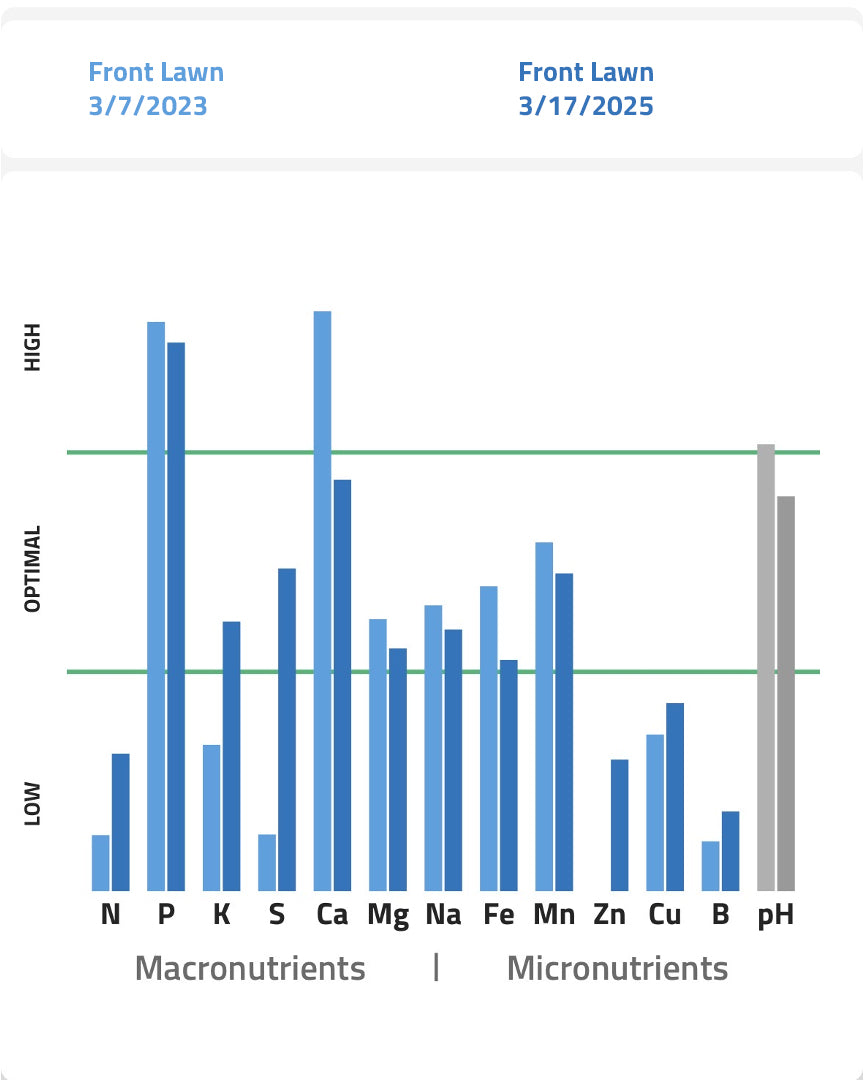
Above is a comparison chart of my MySoil test results about two years apart. It’s notable that I was very pleased with the appearance of this lawn after following the year. I’ll go through each grouping of nutrients and briefly discuss the strategy.
Mobile Nutrients in Soil
Nitrate-Nitrogen (NO3-) – Nitrogen was managed using a 65% slow release nitrogen fertilizer; Curb Appeal is a great example of this kind of fertilizer. Most of the increase you see is actually in the form of ammonium, but nitrogen was slightly increased. Other inputs include nearly exclusively mulching clippings (rarely bagging), and topdressing with compost annually.
Sulfate-Sulfur (SO4-2) – Sulfur was managed as being an ingredient in the fertilizer used for each application. In other words, sulfur was applied each time I fertilized. We know that sulfur isn’t very mobile, so why did it increase? I have a medium textured, silty soil with relatively high organic material. Additionally, I manage my irrigation so as to not leach nutrients below the rootzone and our winters were mild enough to not leach nutrients.
Boron (H3BO3, BO3-) – No additional boron was added in a fertilizer. Compost topdressing was used annually that could have contributed, and in 2024 monthly applications of humic and fulvic acids were applied in a liquid form, potentially enhancing the availability of boron.
Low Mobility or Somewhat Mobile Nutrients in Soil
Potassium (K+) – Potassium was included in the chosen fertilizers and was applied at each fertilizer application during each season. We can see that this small incremental approach did increase potassium over the seasons.
Ammonium-Nitrogen (NH4+) - Nitrogen was managed using a 65% slow release nitrogen fertilizer such as that found in Curb Appeal fertilizer. Ammonium increases were primarily responsible for the total nitrogen increase. Other inputs include nearly exclusively mulching clippings (rarely bagging), and topdressing with compost annually.
Manganese (Mn+2) & Molybdenum (MoO4-) – A micronutrient fertilizer containing copper, iron, manganese, and zinc was applied at the beginning of each growing season. This was supplemented with applications of humic and fulvic acids that should enhance the availability of the micronutrients in the soil. Compost was also applied annually.
Immobile Nutrients in Soil
Phosphorus (HPO4-2, H2PO4-), Calcium (Ca+2), & Magnesium (Mg+2) – These nutrients were present in sufficient amounts, they were not applied across these seasons and you can see that the system drew those down. I’ll continue to monitor and begin applying if the levels drop below the sufficiency range.
Copper (Cu+2) , Iron (Fe+2), & Zinc (Zn+2) - A micronutrient fertilizer containing copper, iron, manganese, and zinc was applied at the beginning of each growing season. This was supplemented with applications of humic and fulvic acids that should enhance the availability of the micronutrients in the soil. Compost was also applied annually. Even with these additions, we can see that the lawn ecosystem used more iron and manganese than was supplied, so the application rate of the fertilizer that supplies these micronutrients will be increased, or an additional application made seasonally in the future.
What are some of the key takeaways? Instead of chasing specific ppm numbers, I like to chase trends over time and adjust the MySoil guidance to my specific lawn and soil. When specific nutrient levels are low, I like to focus on adding those nutrients, while I avoid applying nutrients that are in the optimal range or that we have a surplus of. In those instances, I let plants and soil biology consume those nutrients until there is a need to apply them. I couple this nutrient management strategy with always focusing on slowly but surely increasing organic matter in my soil over time.
Share:
What Do Plant Nutrients Do? Essential Macro & Micronutrients Explained for Healthy Growth